 Guang Chen
Guang Chen
Research
Electrostatics and Viscosity of Polyelectrolyte Solutions
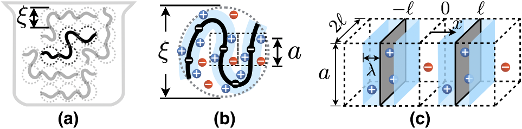
Polyelectrolytes (PE) solutions are charged polymers in polar solvents, which have been extensively studied attributing to their ubiquitous nature and their use in a large number of applications such as energy storage, drug delivery, oil recovery, bio-medical devices and food industry. Due to the electrostatic interactions among the charged monomers and surrounding electrolyte ions, the microstructure and the macroscopic dynamics of the PE chains are responsive to environmental modulations (e.g., added salt and pH). To understand the electrostatics and its contribution to the dynamics of semidilute PE solutions, we introduce cell models with simplified geometries, solve the Poisson-Boltzmann equation within and beyond the Debye-Hückel limit, and analysis the explicit ion distributions for scenarios with non-overlapping and overlapping electric double layers. We identify consecutive regimes dependent on the magnitude of the ratio of the polymer concentration to the salt concentration, which rationalize the unexplained observations and classical PE solution theories and shed light on the effects of polymer concentration, salt contamination, added salt and charge strength on the properties of semidilute unentangled PE solutions. Meanwhile, this new theoretical model can be applied to many other colloidal systems such as polyelectrolytebrushes, clay particle suspensions and bacterial colonies.
Fluid Dynamics in Aerosol Jet Printing
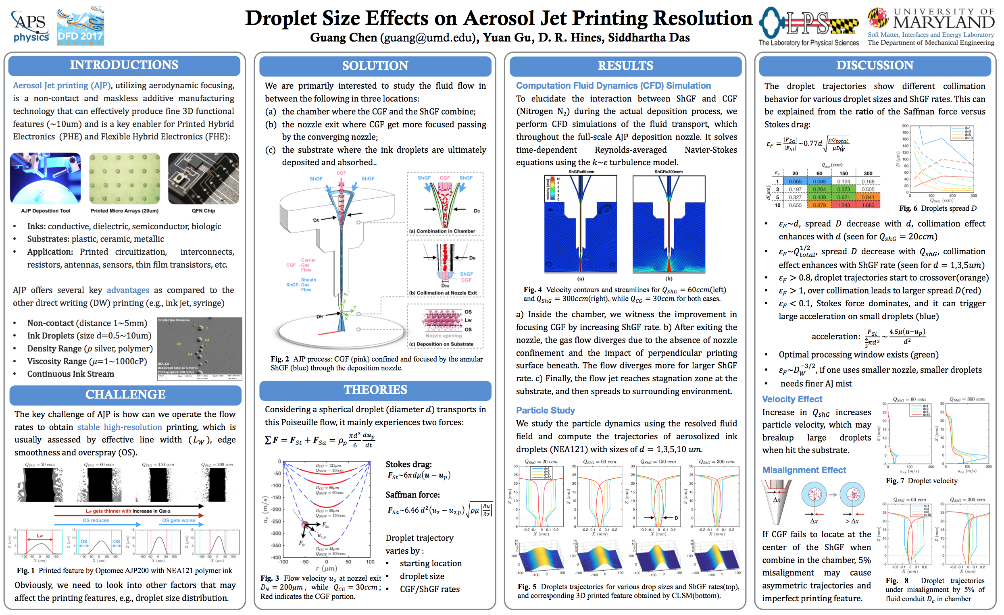
Aerosol Jet printing(AJP) is a breakthrough additive technology enabling finer feature sizes than traditional ink-jetting and screen printing processes. Aerosol Jet printing utilizes an innovative aerodynamic focusing technology that produces electronic and physical structures with feature sizes from 10 microns to millimeters.
I am interested in understanding the fluid dynamics in AJP process, including 1. atomization of the liquid ink(polymers/adhesives/metal nanoparticles, etc.), forming aerosol mist composed of droplets with diameters ranging from 1~5 microns; 2. transport of aerosol mist in carrier gas, and 3. printing morphology at deposition. The objective is to find the correlation between the operable parameters and printing resolutions(line width, edge quality, etc.) via experiments and simulations, address the instability problem, and eventually provide data-sheet for user to produce desired resolution, and to develop the next generation smart operation systems.
Polyelectrolyte Brushes
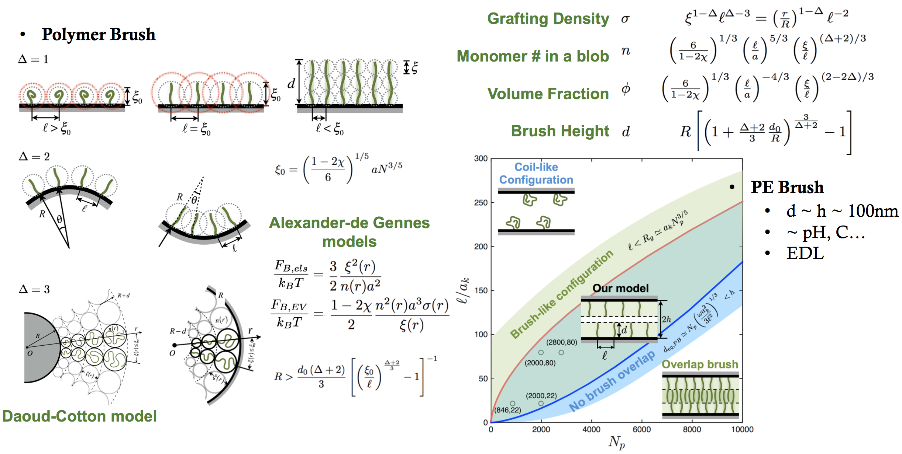
Designing and functionalizing solid-liquid interface play very important roles in nanofluidic systems, such as drug delivery, oil recovery, joint lubrication, and ionic valves. In these applications, one of the most popular techniques to functionalize an interface is to graft it with a layer of Polyelectrolyte (PE). For example, in drug delivery, the medicine particles can be grafted with PE brushes, so that the charged brush systems will carry the medicine as vehicles to find the target and then release the medicine. People also graft the PE brush into the nanochannel, for application of ionic valves. If the environmental condition changes, these brushes will shrink/swell to open/close the channel. That is because they tends to adjust their height to minimize their free energy to get their favorable configuration. Therefore this work is to investigate the thermodynamics, conformation, electrostatics and transport in PE brush grated systems.
Scaling Laws
Brush-like configuration and critical conditions
- Planar PE brush
- Curved PE brush
- Star-shaped: PE brush grafted nano-particles
- Bilayer: PE brush grafted nano-channels
Related Talk:
- “Scaling Laws for Liquid and Ion Transport in Nanochannels Grafted with Polyelectrolyte Brushes”, talk @ 2016 APS March Meeting, Baltimore, MD
Related Publications:
-
- G. Chen and S. Das, “Scaling Laws and Ionic Current Inversion in Polyelectrolyte-grafted Nanochannels.” J. Phys. Chem. B, 119, 12714-12726 (2015) (link)
- S. Das, M. Banik, G. Chen, S. Sinha, and R. Mukherjee, “Polyelectrolyte Brushes: Theory, Modelling, Synthesis, and Applications”, Soft Matter, 11, 8550-8583 (2015) (link)
- G. Chen, H. Li and S. Das, “Scaling Relationships for Spherical Polymer Brushes Revisited”, J. Phys. Chem. B, 120 (23), 5272–5277 (2016) (link)
Brush Conformation and Electrostatics
- Appropriate ionization distribution in pH-responsive PE brushes, suggesting a possible/appropriate PE configuration
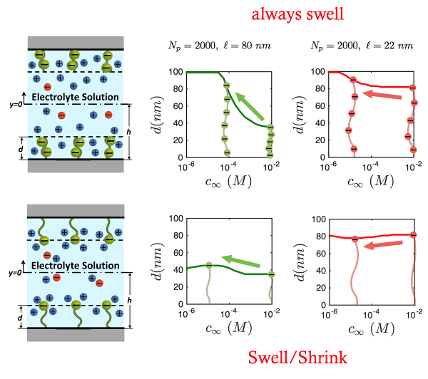
- Anomalous ion-concentration-dependent shrinking/swelling of end-charged PE brushes
Related Publications:
- G. Chen and S. Das, “Anomalous Shrinking-Swelling of Nano-Confined End Charged Polyelectrolyte Brushes: Interplay of Confinement and Electrostatic Effects”, J. Phys. Chem. B, 120, 6848-6857 (2016) (link)
- H. Li, G. Chen and S. Das, “Electric Double Layer Electrostatics of pH-responsive Spherical Polyelectrolyte Brushes in the Decoupled Regime”, Colloids and Surfaces B: Biointerfaces, 147, 180-190 (2016) (link)
- G. Chen and S. Das, “Electrostatics of Soft Charged Interfaces with pH-dependent Charge Density: Effect of Consideration of Appropriate Hydrogen Ion Concentration Distribution”, RSC Adv., 5, 4493 (2015) (link)
Electroosmosis / Streaming Potential / Ionic Current
Electroosmosis(EOS) in nanochannels is widely used in micro-nano fluidic systems, such as bio-sensing, chemical separation techniques. EOS is trigger by electric field on mobile ions in the electrolyte solution, and it is a very efficient way to transport fluid in the nanochannel, comparing with a classic pressure-driven pipe flow that the pressure drop needed to maintain a certain flow speed is very large( it increase inversely as the square of the capillary size).
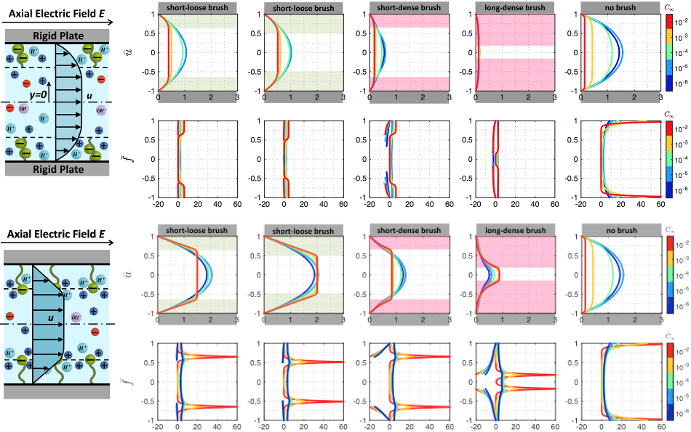
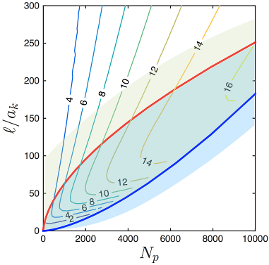
Grafting PE brush into the nanochannel will induce drag to the EOS transport. However, we establish that nanochannels grafted with pH-responsive, end-charged PE brushes demonstrate a massive augmentation in the strength of the EOS transport in the presence of an external electric field, which contradicts the existing understanding. That is because the PE brushes embrace charges and they stretch out to the center of nanochannel, while for rigid nanochannel, the charge is only at the substrate. Therefore the addition of the PE brush localize the electric double layer away from the substrate and the column force on these electrolyte ions suffers less retardation due to the wall shearing stress.
Related Talk:
- “Confinement Effect on Liquid and Ion Transport in Nanochannels Coated with Environmental-stimuli-responsive Polyelectrolyte Brushes”, talk @ 2016 APS DFD, Portland, OR
- “Electrokinetic Transport in Nanochannels Grafted with Polyelectrolyte Brushes with End-Charging”, talk@ 2015 APS DFD, Boston, MA
- “Mobile Electric Energy Generator Based on Nanofluidics”, poster finalist @ 2015 C3E Women in Clean Energy Symposium, Boston, MA,
- “Electrokinetic Transport in Nanochannels Grafted with Polyelectrolyte With pH-Dependent Charge Density”, talk @ InterPACKICNMM2015, San Francisco, CA
Related Publications:
- G. Chen and S. Das, “Massively Enhanced Electroosmotic Transport in Nanochannels Grafted with End-Charged Polyelectrolyte Brushes”, J. Phys. Chem. B. doi: 10.1021/acs.jpcb.7b00493 (2017) (link)
- G. Chen and S. Das, “Thermodynamics, Electrostatics, and Ionic Current in Nanochannels Grafted with pH-responsive End-charged Polyelectrolyte Brushes”, Electrophoresis. 38, 720-729 (2017) (link)
- J. Patwary, G. Chen, S. Das, “Efficient Electrochemomechanical Energy Conversion in Nanochannels Grafted with Polyelectrolyte Layers with pH-Dependent Charge Density”, Microfluidics and Nanofluidics, 20, 37 (2016) (link)
- G. Chen and S. Das, “Streaming Potential and Electroviscous Effects in Soft Nanochannels beyond Debye-Hückel Linearization”, J. Colloid Interface Sci., 445, 357 (2015) (link)
- G. Chen and S. Das, “Electroosmotic Transport in Polyelectrolyte-grafted Nanochannels with pH-dependent Charge Density”, J. Appl. Phys. 117, 185304 (2015) (link)
Fluid Transport in Wood
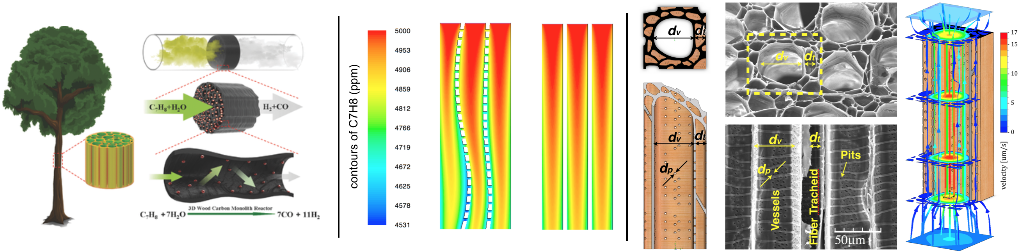
As side and collaborative projects, I have been extensively involved in problems such as contact line dynamics and capillary transport in wood. These series of hydrodynamic studies in mesoporous wood structures are conducted collaboratively with Nanomaterials and Emerging Devices Lab in Materials Science and Engineering at UMD, which involve various topics such as water treatment, catalytic reaction and evaporation induced capillary motion. We utilized theoretical, computational and experimental investigations in understanding how the micro-structure naturally existing in wood affect the contact line dynamics, advection-diffusion-reaction of chemical species and mass/thermal transports.
Related Publications:
- Y. Wang, G. Sun, J. Dai, G. Chen, … S. Das, … L. Hu, “High-Performanced, Low Tortuosity Wood Carbon Monolith Reactor”, Adv. Mater., DOI:10.1002/adma.201604257 (2016) (link)
- F. Chen, A. Gong, M. Zhu, G. Chen, Y. Wang, S. Das, … L. Hu, “Mesoporous, 3D Wood Membrane with Nanoparticles for HighlyEfficient Water Treatment”, ACS Nano. DOI: 10.1021/acsnano.7b01350 (2017) (link)
- M. Zhu, Yiju Li, G. Chen, ... S. Das, L. Hu, "Artificial Tree for High-Efficiency Water Extraction", (submitted to Science Advances)
- S. Sinha; V. Padia; K. Bae; G. Chen and S. Das, “Effect of Electric Double Layer on Electro-Spreading Dynamics of Electrolyte Drops”, Colloids and Surfaces A: Physicochem. Eng. Aspects, 514, 209-217(2017) (link)
Heat Transfer in Curved Cooling Channels
-
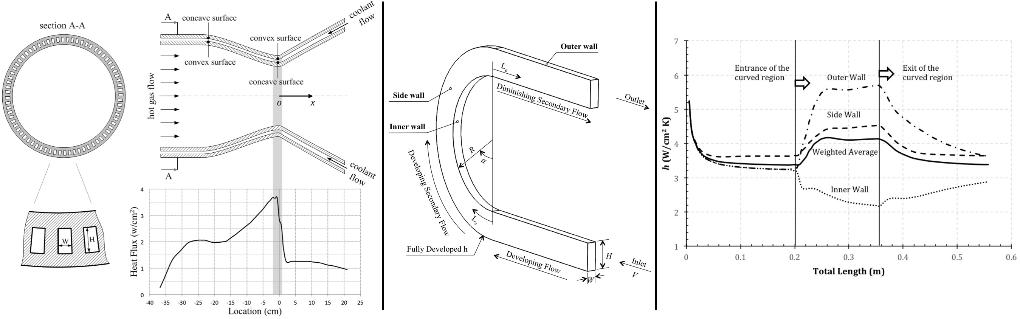
Master Thesis Project, supervised by Prof. Mohammad Naraghi and Dr. Pejman Akbari at Columbia University.
- Applied Fluent to simulate the fluid\thermal performance and determined Heat Transfer Correlations for Curvature Effects on Rocket Engines Cooling Channels.
- Related Publications:
- G. Chen, M. H. Naraghi, P. Akbari, “Effects of Curvature Radii and Aspect Ratios on Cooling Channels Heat Transfer for Liquid Rocket Engines”, Thermal and Fluids Engineering Summer Conference, NYC, 2015 (link)
- R. Cavillon, M. H. Naraghi, G. Chen, “Comparison of Heat Transfer Characteristic of Rectangular and Oval Cooling Channels of Regeneratively Cooled Rocket Engines”, 51st AIAA/SAE/ASEE Joint Propulsion Conf., 2015 (link)
Make a free website with Yola